Shadow Evaluation · 90 Days · Observe Only
For Payers: Shadow Evaluation Guide
Establish a behavioral baseline for AI voice agent transparency — zero vendor changes, zero production risk. Run in parallel with live traffic; observe, collect evidence, decide what to require later.
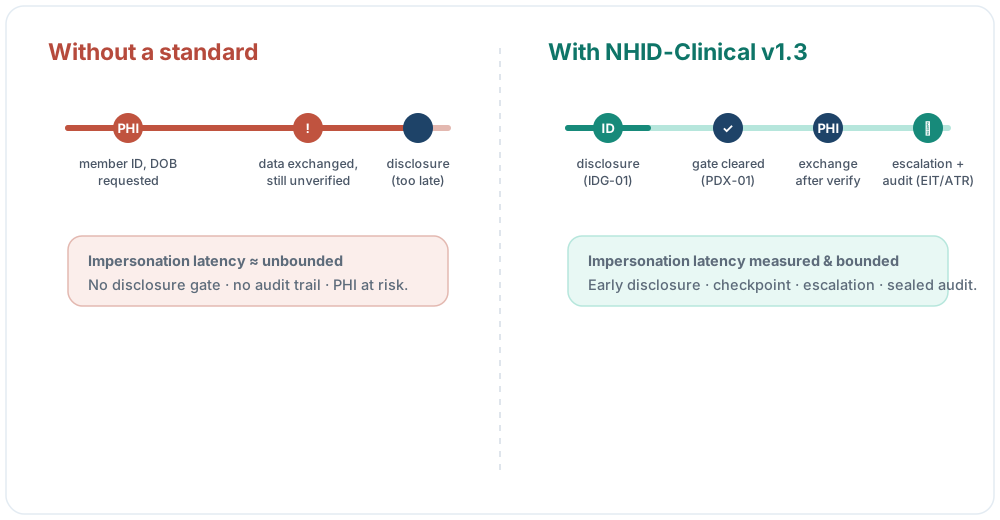
Impersonation latency vs. verified disclosure pathway
Start here — a pilot in three steps
The Tier 0 Shadow Pilot Kit runs on your own call logs. Observe-only, no vendor changes, usable numbers in 2–4 weeks.
1 Get the kit
Download the Tier 0 Shadow Pilot Kit — a minimal event schema, a measurement script, and a report template.
2 Run it on your logs
Map a sample of your call records to the minimal event schema, then run measure_pilot.py. Nothing touches production.
3 Read your numbers
You get impersonation-latency and disclosure metrics on your own traffic in a ready-to-share report. Use it to decide what to require of vendors.
What You Gain
| Metric | Today (typical) | Target with NHID-Clinical |
|---|---|---|
| Verification latency | 3–5 min or call terminated | < 5 seconds |
| Audit effort per vendor | Manual call review (hours) | ~2 minutes (test suite) |
| RFP disclosure language | Custom per vendor | One standard clause |
| Escalation response time | Untracked | ≤ 2 seconds, logged |
How the 90-Day Shadow Evaluation Works
1 Weeks 1–2 — Add RFP Language
Insert this clause into your next voice AI vendor RFP or BAA amendment:
"The vendor's AI agent SHALL produce NHID-Clinical v1.3 JSON trace logs for all B2B administrative calls, including disclosure timestamps and opt-out handling. The payer may run the open-source conformance test suite against vendor output at any time."
Existing contract? Send as a formal amendment request.
2 Weeks 3–6 — Vendor Sandbox Testing
Ask your vendor to run the open-source suite — results in under 5 minutes.
git clone https://github.com/NHID-Clinical/NHID-Clinical.gitpip install -r requirements.txtpython -m pytest tests/ -v- Send full terminal output (+ optional sample traces)
3 Weeks 7–10 — Validate Logs Yourself
- Place vendor JSON traces in
traces/ - Run
python -m pytest tests/ -v - Verify: disclosure before NPI/member ID; no deceptive artifacts; escalation ≤ 2s on request
4 Weeks 11–12 — Measure Impact
- Verification latency (target < 5s)
- Escalation volume from identity uncertainty (target > 30% reduction)
5 Decide Next Steps
- Tests pass + metrics improve → consider requiring conformance in future contracts
- Tests fail or flat metrics → remediation or disqualify from future bids
Evaluation Resources
- Executive Brief → — one-page overview for leadership and procurement
- Shadow Evaluation Guide → — full 90-day process
- Evidence Pack → — guarantees, failure trace, audit model
- Regulatory Alignment → — CMS-0057-F, MACPAC, DOJ FCA, state AI laws
- Reference demonstration line → — hear the disclosure controls in a real call
Get involved
Read the specification. Share what you think.
Whether it is right, wrong, incomplete, or misses the real problem — that feedback shapes the next version.